Wheel Design Variations and Their Influence on Long-Term Player Strategies in Digital Settings
Erik Schmidt · Oct 6, 2026

Wheel Design Variations and Their Influence on Long-Term Player Strategies in Digital Settings
Digital roulette platforms feature wheel designs that range from traditional 37-pocket European layouts to 38-pocket American versions and customized variants with altered sector distributions. These configurations alter probability distributions and payout structures, which in turn shape how participants adjust their approaches across extended sessions. Research indicates that wheel geometry directly impacts expected value calculations over thousands of spins, prompting shifts in bet sizing and selection patterns.
Data from industry monitoring shows that European-style wheels maintain a 2.7 percent house edge while American wheels sit at 5.26 percent. Players who track these differences over months often modify their session lengths and stake progressions accordingly. In October 2026, platform analytics revealed increased adoption of hybrid wheels that incorporate both standard and accelerated spin mechanics, further diversifying decision frameworks.
Core Wheel Configurations in Digital Environments
Standard European wheels contain 37 pockets with a single zero, whereas American designs add a double zero to reach 38 pockets. French variants introduce la partage and en prison rules that reduce effective house edges on even-money bets to 1.35 percent under specific conditions. Digital platforms replicate these layouts through random number generators calibrated to match physical wheel statistics, yet software allows for rapid iteration on pocket placement and sector weighting.
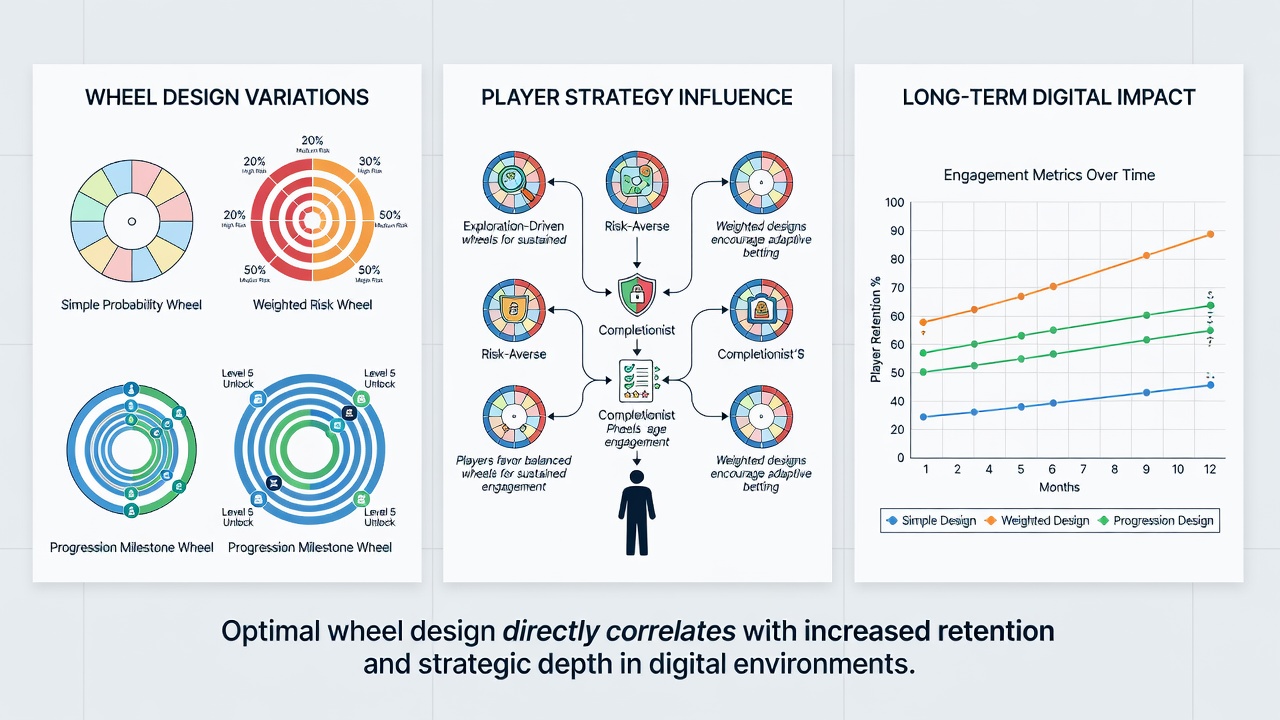
Observers note that pocket adjacency patterns influence perceived clustering effects even when outcomes remain independent. Some platforms introduce visual modifications such as colored segments or animated dividers that highlight certain number groups, which studies link to measurable changes in bet distribution across user bases. Those who examine longitudinal data find that participants exposed to these visual cues maintain different coverage ratios compared with users on plain layouts.
Impact on Extended Strategy Development
Long-term approaches evolve around measurable variance introduced by each wheel type. Higher-edge wheels accelerate bankroll depletion rates, leading participants to adopt tighter loss thresholds and shorter session durations. Lower-edge configurations support extended play periods because the mathematical drain occurs more gradually, allowing for more complex progression systems to unfold before hitting predetermined limits.
Research from academic gaming labs demonstrates that wheel-specific modeling appears in player decision trees after roughly 500 recorded spins. Participants begin weighting outside bets differently once they accumulate sufficient data on their chosen platform's wheel parameters. This adaptation process continues as users encounter new variants, with adjustments accumulating across multiple accounts or sessions.
Platform Data and Behavioral Patterns
Analytics from regulated markets indicate that wheel design correlates with average bet frequency and total wager volume per active user. Platforms offering multiple wheel options simultaneously record users migrating toward configurations that align with their risk tolerance after initial exposure periods. A 2025 report by the Nevada Gaming Control Board documented shifts in play volume following the introduction of new wheel variants, with measurable differences in session duration metrics.
Those who review aggregated platform statistics find that French rule implementations coincide with higher retention rates among certain demographic segments. The reduced house edge on even-money positions encourages sustained participation because recovery sequences remain viable over longer horizons. Digital implementations track these patterns through timestamped bet logs that reveal how strategy layers build incrementally rather than through abrupt changes.
Regulatory Context Across Regions
Authorities in multiple jurisdictions require disclosure of wheel specifications and random number generator certification before platforms launch new variants. The Malta Gaming Authority maintains technical standards that mandate transparent reporting of pocket distributions and return-to-player percentages. Similar frameworks operate in Canadian provinces and Australian states, where operators must submit wheel parameter documentation during licensing reviews.
These requirements create consistent data environments that support comparative analysis across different wheel types. Participants gain access to verified specifications that inform their long-term modeling, while operators receive guidance on acceptable variation ranges that maintain game integrity.
Conclusion
Wheel design variations establish distinct mathematical environments that shape how strategies develop across extended digital play periods. Configuration differences in pocket count, rule sets, and visual presentation produce measurable effects on bet selection, session management, and progression adjustments. Data collected through October 2026 continues to illustrate these relationships as platforms expand their variant offerings and regulatory bodies refine disclosure standards. The resulting landscape provides participants with structured information for refining approaches based on specific wheel characteristics rather than generalized assumptions.